
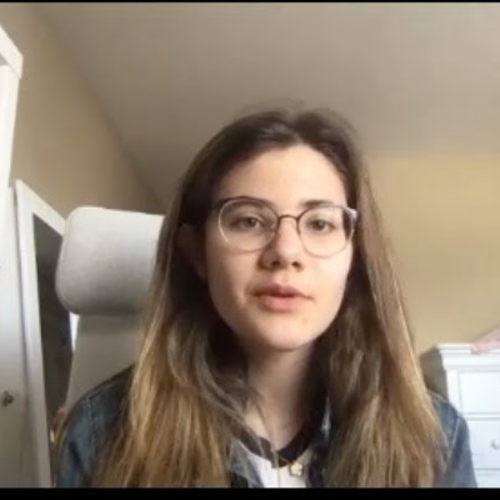
How Aya Chose UBC From Four Offers and Learned to Brand Her Story
Aya applied to four universities, won entrance scholarships at three, and chose UBC over U of T and McGill weighing distance, family, and a year unlike any other. The harder lesson came earlier: she had done the work but never learned to brand it, and it cost her. This is how she learned to tell her own story.
Jump to
I remember scrolling through my school's career and education website, the way you'd dig through a junk drawer hoping the thing you need is in there somewhere. Scholarship listings. Application portals. Deadlines that always seemed to surface a week too late to matter. I knew where I wanted to go. I had a feeling for the kind of life I wanted, something that crossed borders and languages and rooms full of people who didn't all speak the same one. What I didn't have was a way to make any of it legible to the people who decide. How do you take everything you've done and make a stranger see it the way you do?
That question followed me into Grade 12. I'd already started reaching for scholarships on my own, the big ones, the kind that change what your next four years cost. And I had done the work to deserve a shot at them. But sitting down to write, I realized I had no idea how to put myself on the page.
The Thing My School Couldn't Give Me
For a long time, the help arrived late or not at all. Information about awards would reach me with barely enough runway to plan, let alone write something I was proud of. So I went looking for guidance that knew the road, that could teach me how to navigate it rather than just point at a finish line.
That is what pulled me toward AdmissionPrep. I wasn't looking for someone to do it for me. I was looking for people who had walked this exact path and could hand me the tools to do it well, then trust me to use them. The frameworks, the honest feedback, the structure I had never been taught. That was the part I was missing, and it turned out to be the part that mattered most.
What I Learned About My Own Story
Here is the lesson I wish someone had told me a year earlier. Doing the work is only half of it. The other half is knowing how to brand yourself, how to tell a committee what your work actually meant.
Before the program, I applied to a few scholarships completely on my own. Big ones. And I lost them. Not because I hadn't done enough, I had pages of extracurriculars, real involvement, real hours. I lost them because I didn't brand myself the way I could have. I just wrote. I poured everything out, open and self-reflective, and assumed the substance would speak for itself. It didn't. The substance was there. The framing wasn't.
That regret reshaped how I think about every application since. Your activities are not a list. They are evidence. And evidence only counts if you know how to present it.
The Skills That Changed My Writing
The most useful thing the program gave me was a way to write that I'd never been shown. The STAR method. How to open with a hook. The small craft of using specific language instead of vague gestures, so a reader feels the moment instead of skimming past it.
I had genuinely never thought about how to format a response before. I'd treated scholarship essays like journaling, just me thinking on the page. But there is a structure to it, and the more structure a response has, the more a committee can actually receive what you're trying to say. Once I learned to communicate exactly what I meant, my writing stopped being a confession and started being an argument. That shift is the whole game.
Treating It Like the Job It Is
None of this was light. I was carrying a full course load and working through the year, so the only way through was to be deliberate about it. I carved out fixed blocks of time, a standing appointment with myself, and protected them. Time management wasn't a nice-to-have. It was the thing holding the whole season together.
Managing university and scholarship applications at once is almost a part-time job, and the deadlines do not care how busy you are. But I learned something that took the edge off the panic. The earlier you finish a draft, the more time you have to submit it for editing, to look it over, to be sure you're putting your genuine best foot forward. Finishing early isn't about being ahead. It's about leaving room to be good.
Four Offers, and a Real Choice to Make
I applied to four universities: UBC, the University of Toronto, McGill, and SFU. And one by one, the offers came in, each carrying an entrance scholarship.
UBC offered around three thousand dollars. The University of Toronto came back with the biggest one, seventy-five hundred for the entrance award plus another three thousand renewable. McGill added a three thousand dollar entrance scholarship of its own. Around seventeen thousand dollars in awards, all told.
Then came the part nobody warns you about: choosing is hard when you've worked to keep your options open. I weighed all of it. The money, yes, but also the distance from home, and the moment we were living through. With everything happening in the world that year, staying close to my family felt like the right call. I chose UBC. Not because it was the only door open, but because I'd earned the privilege of picking which one to walk through.
The Word: Branding
If I had to put this whole journey into one word, it would be branding.
I don't mean it in some glossy, marketing sense. I mean the discipline of knowing your own story well enough to tell it true. Before, I had done meaningful things and left them undefined on the page, hoping someone would connect the dots for me. Now I understand that the dots are mine to connect. If community service is who you are, then you name the specific issues you cared about, the specific problems you helped solve, so that when you sit down to write, you already know exactly what you did and exactly how it changed you.
One habit made all of it possible. I recorded my hours for everything, and more than that, I documented the meaning. A photo here, a few honest sentences there, written right after a fundraiser or a meeting, just for myself, about what it actually did to me. By the time an application asked, I wasn't reaching for memories. I had a record of impact, and I could brand it because I'd already lived inside it.
A Note to the Next Grade 11 Kid
Start as early as you can. I mean it. I thought about starting in Grade 11, but I didn't know how, and I didn't get the support to figure it out, so I waited. I'll be honest about what that cost me. I believe I could have won scholarships in my Grade 11 year, when I had more room to breathe and wasn't buried under university applications. That is the one thing I would go back and change.
And do work that genuinely matters to you, even if it's only one or two things. Go deep instead of wide. Reflect on it, make sure it's something you actually care about, because that's what lets you brand it later and that's what a committee can feel. They can always tell the difference between a checkbox and a calling.
Where I Stand Today
This fall I'm starting at UBC in International Relations, with plans to pick up a couple of languages along the way. I want to work internationally, with non-governmental organizations, maybe one day the UN, maybe as a diplomat for the Canadian government. Global politics has pulled at me for as long as I can remember, and for the first time the path to it feels like mine to walk.
The strange thing is that the skill I leaned on to get here, learning to say exactly what I mean in as few words as possible, is the same skill that whole career will run on. AdmissionPrep didn't hand me my story. They taught me how to tell it. And once you know how to brand what you've done, you stop hoping people will see you, and you start making sure they do.