
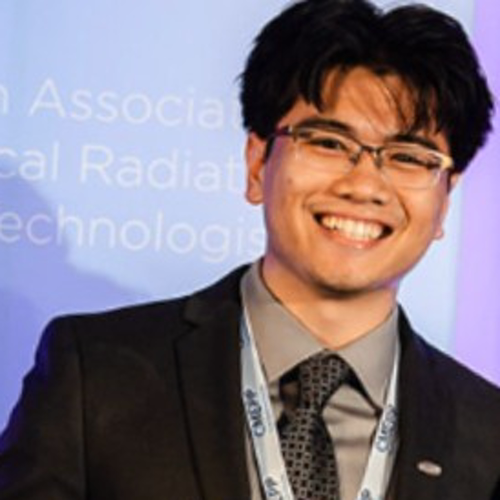
How Leyton Got Into His First-Choice Program at the University of Alberta (and Won $96,000)
Leyton knew he wanted to be a radiation therapist before he had any idea how to get there. Here is how he reverse-engineered what admissions and scholarship committees actually reward, built an authentic story around his Filipino immigrant experience, and earned a spot in his first-choice program at the University of Alberta along with roughly $96,000 in awards.
Jump to
There is a kind of certainty that arrives before the plan does. I was a kid in Abbotsford who already knew the shape of his life: I wanted to be a radiation therapist, to sit with cancer patients and their families on the worst days and be one of the people who made those days a little more bearable. The want was clear. The path to it was not. I know exactly where I am going. So why do I have no idea how to get there?
The summer before Grade 12, I did the only thing that felt like control. I made a list of every university I wanted to attend and built a spreadsheet of due dates, admissions and scholarships both. I sat there with the whole map in front of me and still felt lost, because a list of names is not a route. I knew the schools. I did not know how anyone actually got in, or where a person was even supposed to start with scholarships.
The Program I Could Trust
What I wanted was not someone to do it for me. I wanted someone who had walked this road and would walk it beside me, pointing out the turns I could not see yet, while the work stayed mine. Becoming a radiation therapist is not a thing you can outsource, and neither, I figured, was getting there.
So I started with AdmissionPrep. Not a shortcut. A set of tools and frameworks and people who had done this before, all there to guide the work while leaving the work to me. The first thing it gave me was a place to start. The scholarship matching showed me exactly which awards I was eligible for, so I stopped drowning in options and started aiming at real targets.
Building Something Real
Here is what I learned early, and it changed everything: universities and scholarship committees are not counting your accolades. They are looking for community engagement, for someone who leads, who initiates, who builds something that was not there before. Once I understood that, I stopped collecting activities and started serving with intent.
The thing I am proudest of came straight out of my own life. I am the child of Filipino immigrants, and I knew what it felt like to look for a sense of home in a place that was not yet home. So I founded a multicultural club, built around cultural enrichment, to give students from every background a place to belong. It was not for a checklist. It came from something real, and that is why it lasted. That club became the heart of my SFU application, the place where my story finally read like one person instead of a list. The passion was not a strategy. It was the whole point.
The People in My Corner
I did not do the writing alone, but I did do the writing. There is a difference, and it mattered to me. The advisors taught me how to structure an essay, what language committees respond to, how to make a reader feel the thing I was trying to say. One edited my SFU application down the home stretch and told me she could feel the passion coming off the page. I carried that into every draft after.
More than the techniques, it was the peace of mind. Experienced people were guiding me through a process that is genuinely stressful, and knowing they were there let me take swings I would have been too scared to take alone. I came out a stronger writer, and that is a skill I will use every time I apply for an award in university, the same process again, only now I know how.
When I Pushed Too Hard
I want to be honest about the part nobody photographs. I wanted this so badly that I overdid it. There were stretches where I poured every hour into scholarship applications and let everything else slide, my homework, my other responsibilities, the basic maintenance of being a person. I told myself I would sleep when it was over.
You can accomplish a lot that way. You also pay for it. The toll lands on your emotional and physical health, the two things you need to survive a year like this. I learned the hard way that grinding yourself to exhaustion is not the same as working hard. The students who make it through are the ones who learn to pace the climb.
What saved me was a small habit. Every morning I built a rough schedule of what I wanted to finish that day, not rigid, because the day always changes, but real. Every little task I crossed off lit a fuse for the next one. Finish one thing, and you feel just enough motivation to finish another. String enough together and the day carries itself.
The Notifications
Then the answers started coming in, and they did not stop. An SFU entrance scholarship worth $27,000. A University of Alberta scholarship worth around $30,000. A McGill entrance award. A McMaster honours scholarship. A UBC Centennial scholarship. Roughly $96,000 in awards by the end of the cycle, and watching them arrive one after another did not feel real.
But the money was never the deepest prize. The real prize was the choice it bought me. I chose the University of Alberta because it offered me my first choice, the radiation therapy program I had been pointed at this whole time, with a backup program at the same school in case I ever wanted to change course. First choice with a safety net, fully funded. Most students never get to stress over a problem that good, and I do not take it for granted.
The Word: Foresight
If I had to put this whole journey into one word, it would be foresight.
Foresight is what turned a vague dream into a plan. It is what made me study the criteria before I built my extracurriculars, so that community engagement and leadership were woven into my high school years on purpose, not stumbled into by accident. It told me, early, that the things committees reward are not trophies but service.
That same foresight is what I am taking into university. The career is clear. I am going to work with cancer patients, and the writing tools and scholarship process I learned this year are coming with me, because in university it all simply repeats. I already know how it goes, and I get to see the next turn before I reach it now. That is the thing I did not have when I started.
A Note to the Next Grade 11 Kid
If you take one thing from my story, take this: it is never too late to start something you genuinely want to do. Almost every activity I wrote about in my applications, I initiated in Grade 11 or Grade 12. Do not let the it is too late mindset talk you out of beginning. Show the effort, the passion, and the leadership it takes to build something, and you can become a scholarship recipient too, right from where you stand now.
The second thing I had to learn by getting it wrong. Take breaks. Protect your health like the asset it is. You can do an enormous amount in a year, but not at the cost of the body and mind you need to enjoy what you win. Build your day in small wins, and reserve the rest for being a human being.
And if you are a parent reading this, here is the honest filter. This is the right kind of program for the student who will actually do the work, who takes feedback and keeps going, who has a goal they are willing to grind for. It will not carry your child across the finish line. It will hand them the map and teach them to read it.
Where I Stand Today
I started with a destination and no directions. I am leaving with both, headed to the University of Alberta this fall to study radiation therapy, my first choice and fully funded.
Foresight is not magic. It is just looking up far enough ahead to see the turn before you reach it. I could not do that two years ago. Now I cannot stop. The view from here is the whole road, and for the first time, I can see exactly where it leads.