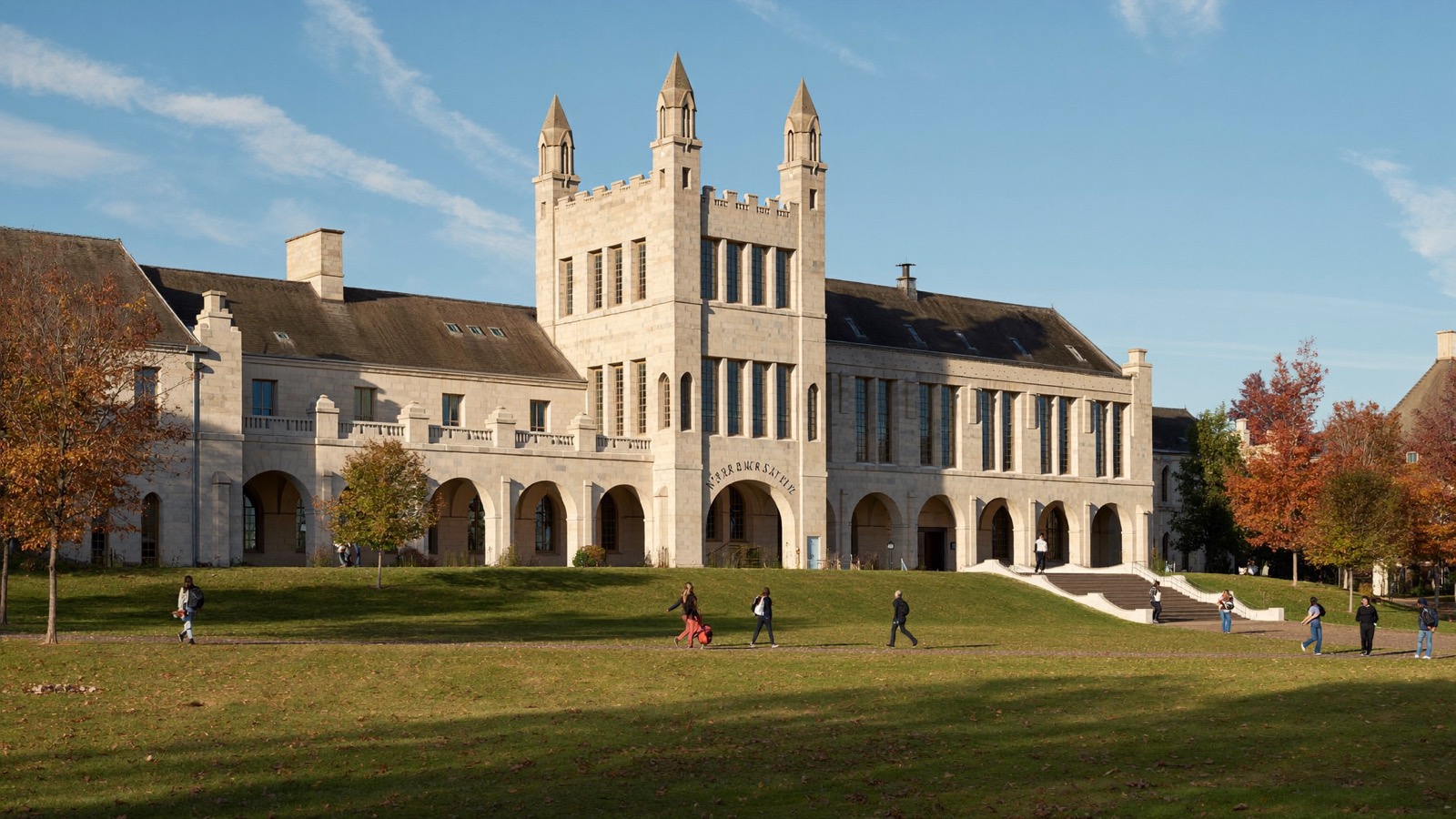
UBC Entering Averages 2026: Mean and Minimum by Program
UBC's 2026 entering averages for all 18 Vancouver programs, with the mean and minimum side by side, how they changed from 2025, and what that means for you.
Jump to
- Where do these numbers come from?
- UBC Vancouver entering averages: 2026 and 2025
- What changed from 2025 to 2026?
- What does the gap between the mean and the minimum tell you?
- UBC Okanagan entering averages for 2026
- What average do you need for UBC Computer Science?
- How should your family use these numbers?
- When are UBC's deadlines for 2027 entry?
- How do you close the gap with the Personal Profile?
- Frequently asked questions
- Ready to aim for the mean, not the minimum?
Most universities give you one number. UBC gives you two.
For each Vancouver program, UBC publishes the mean and the minimum average of the students who entered. The newest table covers the class that started in 2026. You can find it in a counsellor presentation most families never see.
In 2026, mean averages across UBC's 18 Vancouver programs ran from 81 to 97. Engineering was highest at 97. Minimum averages ran from 70 to 90.
Put the 2026 table next to 2025's and something else stands out: the minimum is the number that moves. Here's the full table, and here's how to read it.
Where do these numbers come from?
They come from UBC's "Counselor Information Session 2026" deck, on a slide titled "UBC Vancouver Entering Program Averages for 2026." Each program has two columns, which UBC labels "Mean Average" and "Minimum Average."
The 2025 figures come from the 2025 deck. That slide adds a footnote: "Mean entering ranges are approximate."
Two things to keep in mind before you read the table:
- These numbers describe the class that entered in 2026. They are not the bar for the year your child applies.
- A minimum average is not a cut-off. It's the lowest entering average UBC reports for that program. Your child could sit above it and still not receive an offer.
UBC Vancouver entering averages: 2026 and 2025
| UBC Vancouver program | 2026 mean | 2026 minimum | 2025 mean | 2025 minimum |
|---|---|---|---|---|
| Engineering | 97 | 89 | 97 | 95 |
| Commerce (Sauder) | 96 | 86 | 95 | 85 |
| Science | 96 | 85 | 96 | 85 |
| Kinesiology | 95 | 89 | 94 | 85 |
| Pharmaceutical Sciences | 94 | 85 | 95 | 89 |
| International Economics | 94 | 87 | 94 | 89 |
| Design | 94 | 90 | 95 | 91 |
| Applied Biology | 92 | 85 | 92 | 85 |
| Food & Nutrition | 92 | 85 | 91 | 85 |
| Arts | 92 | 85 | 92 | 85 |
| Dental Hygiene | 92 | 87 | 92 | 83 |
| Music | 90 | 70 | 90 | 75 |
| Media Studies | 90 | 78 | 91 | 71 |
| Natural Resources | 90 | 82 | 90 | 79 |
| Fine Arts | 89 | 74 | 90 | 72 |
| Food and Resource Economics | 89 | 85 | 91 | 86 |
| Urban Forestry | 88 | 78 | 88 | 80 |
| Indigenous Land Stewardship | 81 | 70 | 82 | 74 |
Source: UBC, "UBC Vancouver Entering Program Averages for 2026" and "UBC Vancouver Entering Program Averages for 2025." UBC notes that the 2025 mean entering ranges are approximate.
What changed from 2025 to 2026?
The means barely moved. In 17 of the 18 programs, the 2026 mean sits within one point of 2025's.
The minimums tell a different story. Here are the biggest shifts:
- Media Studies: the minimum rose from 71 to 78.
- Engineering: the minimum fell from 95 to 89, while the mean held at 97.
- Music: the minimum fell from 75 to 70.
- Kinesiology and Dental Hygiene: both minimums rose four points, to 89 and 87.
- Pharmaceutical Sciences: the minimum fell from 89 to 85.
What does this mean for you? Don't plan around a single year's minimum. It can swing several points in either direction. The mean is the steadier guide to where entering Scholars sat.
What does the gap between the mean and the minimum tell you?
The gap is a clue to how much besides the average was in play.
UBC says it evaluates Grade 11 and Grade 12 academic performance alongside a Personal Profile, a set of written answers about your experiences beyond the classroom. Some programs also ask for an interview, portfolio, audition or video.
When the mean and the minimum sit close together, most entering Scholars had similar averages. When they sit far apart, UBC admitted Scholars across a wide band. That points to something besides the average helping decide who got in.
One caution. Six programs share a 2026 minimum of exactly 85, and the slide doesn't say how many students entered near it. Treat each minimum as the lowest reported figure, not a common result.
Here's what the gaps look like in practice.
UBC Engineering average: one mean, two very different minimums
Engineering's mean was 97 in both years. Its minimum was 95 in 2025 and 89 in 2026.
So the two-point gap of 2025 became an eight-point gap a year later. If your child read only the 2025 table, Engineering looked like a program decided almost entirely by grades. The 2026 table shows more room.
Grades still come first. A mean of 97 is the highest in the table. But the Personal Profile has more room to matter than one year of data suggested.
UBC Science and Sauder averages: gaps of ten points or more
Science had a mean of 96 and a minimum of 85 in 2026. Commerce (Sauder) had a mean of 96 and a minimum of 86.
So the lowest entering average UBC reports for Science sat 11 points below the mean. A gap that wide is hard to explain by grades alone.
In these programs, the numbers leave room for the Personal Profile to move a decision. Treat it as a deciding factor if your child sits below the mean. Don't treat it as a formality if your child sits above it.
Pro Tip: Don't read an 85 minimum as "an 85 gets you in." Read it as the lowest figure UBC reports, for reasons the table doesn't show. The mean of 96 is the better guide to where admitted Scholars sat.
Design and Food and Resource Economics: the tightest bands
Two programs had a gap of just four points in 2026. Design had a mean of 94 and a minimum of 90. Food and Resource Economics had a mean of 89 and a minimum of 85.
Design's minimum of 90 is the highest in the table. If Design is on your child's list as a "creative" option, plan for it like a competitive one.
Kinesiology: a mean of 95
Kinesiology had a mean of 95 and a minimum of 89 in 2026. Both figures rose from 2025.
Kinesiology is sometimes treated as the gentler road to a health career. At UBC, its 2026 mean sits one point below Commerce and Science.
Want a plan built around your child's numbers? Our Educators help Scholars build the grades and Personal Profile their target programs ask for. Join the program waitlist.
UBC Okanagan entering averages for 2026
UBC publishes the same two columns for its Okanagan campus.
| UBC Okanagan program | 2026 mean | 2026 minimum | 2025 mean | 2025 minimum |
|---|---|---|---|---|
| Nursing | 94 | 85 | 93 | 78 |
| Engineering | 92 | 85 | 92 | 80 |
| Science | 90 | 75 | 90 | 70 |
| Health and Exercise Science | 88 | 80 | 87 | 75 |
| Commerce | 87 | 70 | 87 | 70 |
| Fine Arts | 87 | 73 | 87 | 70 |
| Arts | 86 | 80 | 85 | 70 |
| Sustainability | 86 | 74 | 88 | 80 |
| Media Studies | 83 | 72 | 84 | 70 |
Source: UBC, "UBC Okanagan Entering Program Averages for 2026" and "for 2025." The 2025 slide lists Commerce as Management.
Okanagan Nursing had a 2026 mean of 94. That's above Vancouver Arts, Applied Biology and Food & Nutrition, all at 92. Its minimum also rose seven points, from 78 to 85.
If your family sees Okanagan as the safety option, check the program, not just the campus. Okanagan Nursing is one of several hidden competitive programs at schools families treat as backups.
What average do you need for UBC Computer Science?
There isn't one in the table, because high school students can't apply directly to UBC's Department of Computer Science.
UBC CS lists three ways in:
- Science (BSc): complete first year Science, then apply to Computer Science.
- Arts (BA): complete first and second year Arts, then apply.
- Commerce (BCom): once admitted to Sauder, apply to the Combined Major in Business and Computer Science.
For a pure CS degree, Science is the faster route: one year instead of two. That makes Science the number to watch, with a 2026 mean of 96.
If your child is set on Computer Science, the competition happens twice. Once to get into the faculty, and again to get into CS.
How should your family use these numbers?
Here's a simple way to read your child's position against any row.
- Above the mean. Grades are a strength. The Personal Profile now decides how strong the application is.
- Between the minimum and the mean. Your child is in range, and the Personal Profile carries more weight. This is where most of the work pays off.
- Below the minimum. UBC reports no entering average this low for that program in 2026. That isn't a final answer for a Scholar in Grade 9, 10 or 11. It is a clear signal about where to focus next.
Pro Tip: Use the mean as your target and the minimum as your warning line. As Engineering showed, a minimum can move six points in a year.
For how UBC compares with other universities, see the hardest programs to get into in Canada.
When are UBC's deadlines for 2027 entry?
UBC's dates page lists these for Canadian high school applicants starting in September 2027:
- Early October 2026: applications opened.
- December 1, 2026: deadline to apply if you want to be considered for UBC's major entrance awards, including the Presidential Scholars Award.
- January 15, 2027: application deadline.
UBC says it makes admission decisions for high school applicants on a continuous basis, from November 2026 through June 2027. Its 2026 deck says most offers are released by March to April.
Early, complete applications get looked at early. So the Personal Profile needs to be at its best on the day your child submits. For the full provincial timeline, see this guide to BC university applications, transcripts and deadlines.
Your child's Personal Profile is the part of a UBC application you can still shape. Apply to our program waitlist to work on it with an Educator.
How do you close the gap with the Personal Profile?
The Personal Profile is where Scholars between the minimum and the mean win or lose ground.
UBC asks about your experiences: what you did, what you learned and why it mattered. Generic answers blend together. Specific answers stand out.
Here's a structure that works. Use the STAR method for each experience:
- Situation: where you were and what was happening.
- Task: what you were responsible for.
- Action: the specific steps you took.
- Result: what changed, and what you learned.
Most weak answers skip straight from Situation to a vague Result. The Action is where UBC sees who you are.
Pro Tip: Start collecting stories now, while you're living them. A Grade 10 Scholar who writes down one real example a month has a year of material by the time applications open.
For a full walkthrough, read the UBC Personal Profile guide. If Sauder is the goal, see these UBC Sauder Personal Profile examples. For the whole application, start with the complete UBC admissions guide, and for how supplementary components work across Canada, see what a supplementary application is.
Frequently asked questions
What average do you need for UBC Engineering?
For the class that entered in 2026, UBC Vancouver Engineering had a mean average of 97 and a minimum average of 89, according to UBC's counsellor presentation. In 2025 the minimum was 95. Neither figure is a published cut-off.
What average do you need for UBC Sauder?
UBC Commerce (Sauder) had a mean average of 96 and a minimum of 86 in 2026. The ten-point gap suggests the Personal Profile mattered in who was admitted.
What is the difference between UBC's mean and minimum entering average?
The mean is the average of the students who entered a program. The minimum is the lowest entering average UBC reports for that class. Neither one is a cut-off.
What average do you need for UBC Science?
UBC Science had a mean average of 96 and a minimum of 85 in 2026, the same as in 2025. Science is also the fastest route into a pure Computer Science degree at UBC.
Can you get into UBC with an 85 average?
In 2026, UBC reported a minimum average of 85 for Science, Pharmaceutical Sciences, Applied Biology, Food & Nutrition, Arts and Food and Resource Economics. Those programs had means from 89 to 96, so an 85 sat well below the typical entrant.
When is the UBC application deadline for 2027?
UBC's dates page lists January 15, 2027 as the application deadline. Canadian applicants who want to be considered for UBC's major entrance awards must apply by December 1, 2026.
Ready to aim for the mean, not the minimum?
UBC Engineering's 2026 entrants averaged 97. Ninety-seven. That was the highest mean of any Vancouver program.
Your child doesn't have to guess where they stand. AdmissionPrep works with ambitious Scholars who want to get into top programs like these and make a real impact once they arrive.
Complete our Program Assessment to see where your child stands today. Because our Educators work one-on-one, spots are limited, so if you're ready to start, apply to our program waitlist.
UBC's motto, Tuum Est, means "It is yours." With the right grades, a sharp Personal Profile and an early start, maybe we'll see you on campus as a Thunderbird soon.